Skip the City: Why Suburbs and Small Towns Are Winning the Delivery Robot Race
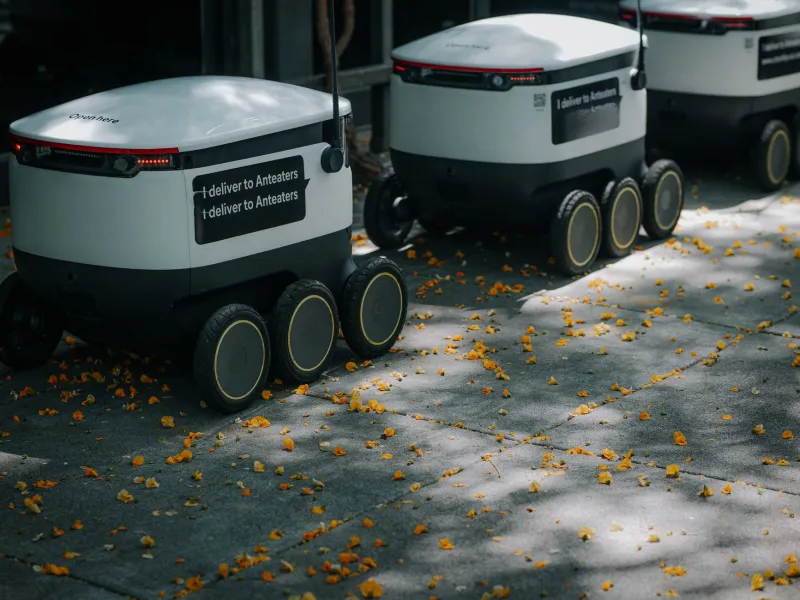
The conventional wisdom about delivery robotics wrote itself years ago: the future belongs to dense cities, where restaurants, customers, and orders stack on top of one another and every mile driven serves hundreds of potential stops. It was a reasonable assumption. It may also be wrong. Across the American heartland, sidewalk delivery robots are finding their most enthusiastic adoption not in Manhattan or San Francisco, but in suburban subdivisions and towns of fifty thousand — and the unit economics explain why.
The Density Paradox
Cities offer density, but density is a double-edged proposition for a machine that travels at walking speed. Urban sidewalks are crowded, obstructed by café seating and construction barriers, and governed by overlapping municipal rules that can change at every crossing. Traffic — both vehicle and pedestrian — slows robots precisely where time matters most. Meanwhile, big-city labor markets make human couriers plentiful and cheap enough that a robot must be exceptionally efficient to justify its capital cost.
Suburban America inverts nearly every variable. Sidewalks are wide and mostly empty. Distances between homes are longer, but each trip is simpler and more predictable. Regulations are lighter: a town council of a few thousand residents is far more approachable than a metropolitan transportation authority. And critically, suburban labor markets make human delivery expensive or simply unavailable — the local pizza place in a small town often cannot hire drivers at all, especially at lunch.
The Startups Leading the Shift
San Francisco-based Starship Technologies, perhaps the most experienced operator in the space, has leaned deliberately into campuses and smaller markets, reporting millions of autonomous deliveries concentrated in exactly these environments. Its robots, which navigate sidewalks at pedestrian pace and complete most trips in under thirty minutes, have become fixtures at university towns across the Midwest and in suburban developments where late-night food options are scarce.
Dallas-based Coco operates a remotely assisted model — a human safety operator supervising multiple robots — a structure well suited to lower-density routes where exceptions are rare. Meanwhile, Kiwibot, which grew out of Berkeley, has partnered with campus dining operators and suburban shopping centers, treating each deployment as a self-contained micro-network rather than part of a sprawling city grid.
Behind the robots sits an equally important layer: micro-fulfillment. Companies such as Takeoff Technologies and Fabric build compact automated warehouses that fit inside existing retail footprints, positioning inventory minutes from the customer. In a suburb, a micro-fulfillment site can cover an entire trade area; in a dense city, it covers a handful of blocks.
The Economics of the 40-Minute Trip
The math favors low-density markets in ways that surprise newcomers. A delivery robot's cost structure is largely fixed — the vehicle, its maintenance, its fleet software. What varies is the value of each completed trip and the probability of failure. In suburbs, a robot servicing a residential zone of a few square miles completes trips with minimal interference, no parking, and no tipping disputes. Average order values tend to be higher, since suburban households order for families rather than individuals.
Compare that with the city, where a robot may spend ten minutes navigating a single congested intersection, and where a blocked sidewalk can strand a delivery entirely. When operators talk about the '40-minute advantage' — a robot completing an order cycle in dense suburbs faster than a car-based courier could in gridlocked traffic — they are describing a genuine structural edge, not a marketing line.
An Honest Caveat
The argument has limits. Small towns offer smaller absolute demand; a robot fleet can only serve so many orders per day, and some rural markets will never generate the volume to justify deployment. Weather in northern states poses real operational challenges. And sidewalk robots, however charming, raise legitimate questions about accessibility for wheelchair users and pedestrians — questions operators must take seriously rather than treat as public-relations friction.
Still, the trajectory is hard to ignore. The future of last-mile logistics is often imagined as a dense urban swarm, but the technology is quietly proving itself in cul-de-sacs and college towns first. The robots did not skip the city by accident. They went where they were wanted, where the sidewalks were clear, and where the numbers worked — and for now, that is small-town America.