Trillions of Tenants: The Startups Decoding America's Gut to Rewrite the Prescription
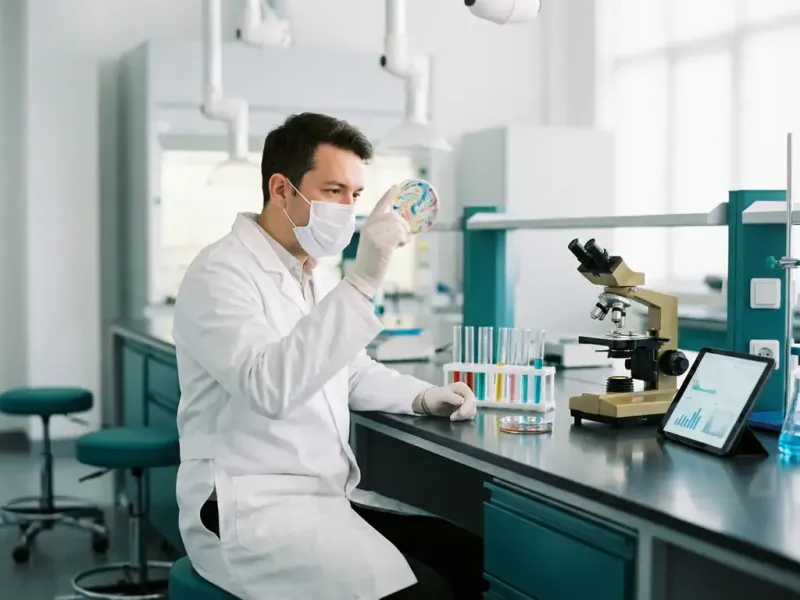
Photo: scientist examining gut bacteria microbiome sample in biotech laboratory, via cryptobiotix.com
For most of modern medical history, the roughly 100 trillion bacteria living in the human gut were treated as background noise — present, plentiful, and largely ignored. That assumption is collapsing. A wave of American startups is now treating the microbiome not as a curiosity but as a diagnostic goldmine, one whose readouts could determine what you eat, which drugs work for you, and how your mind responds to treatment.
The Sample That Started a Company
The infrastructure story begins with testing. Companies such as Viome, headquartered in Los Alamos, New Mexico, and Seed Health in Los Angeles built their businesses on a simple premise: the composition of gut bacteria varies enormously between individuals, and that variation carries clinical meaning that conventional bloodwork misses.
Viome, spun out of the Los Alamos National Laboratory ecosystem, sequences the RNA of a customer's gut microbes and applies machine learning to translate the results into dietary recommendations — which vegetables to favor, which to avoid, which supplements are worth the money. Seed, meanwhile, has pushed toward clinical rigor, running randomized trials on its probiotic formulations rather than relying on the wellness-adjacent marketing that has long plagued the category.
The distinction matters. The microbiome field has attracted more than its share of hype, and the startups earning credibility are the ones publishing peer-reviewed data and pursuing regulatory pathways rather than selling vibes in a capsule.
Why Your Prescription Shouldn't Look Like Your Neighbor's
The most commercially significant application may be pharmacology. Researchers have documented cases where gut bacteria metabolize medications before the body can absorb them, effectively lowering the dose a patient receives. Variations in microbial composition may help explain why a drug that works reliably in clinical trials produces wildly different outcomes across the population.
Startups in this space are building predictive models that pair a patient's microbiome profile with drug-response data, aiming to flag in advance which therapies are likely to succeed. For oncology drugs in particular — where a failed course of treatment costs months and six figures — the economic case is straightforward. If a microbiome screening can meaningfully narrow treatment options before the first infusion, insurers will eventually want it in the pipeline.
The Gut-Brain Corridor
Then there is the mind. The so-called gut-brain axis has moved from fringe science to funded science, with the National Institutes of Health supporting research into how microbial metabolites influence mood and cognition. Companies such as Axial Therapeutics in Cambridge, Massachusetts, are developing therapies targeting the gut to treat neurological conditions, an inversion of the traditional brain-first approach.
Skeptics rightly caution that the gut-brain connection is easily oversold. But the underlying mechanism — the vagus nerve, immune signaling, microbial production of neurotransmitter precursors — is well established in animal models. The commercial question is whether human trials will validate what mice have already demonstrated.
The Obstacles in the Road
Three problems stand between the current moment and mainstream adoption.
First, standardization. Microbiome samples degrade quickly, and results can vary based on how a sample is collected, shipped, and processed. Building a clinical-grade testing network across all fifty states is an unglamorous but essential undertaking.
Second, reimbursement. No consumer product scales in American healthcare without insurance coverage, and payers will demand outcomes data before covering microbiome-informed care.
Third, causation. Most microbiome research to date shows correlation. Distinguishing whether an altered microbiome causes a condition or merely accompanies it remains the field's hardest scientific problem.
One Size Fits Nobody
The broader thesis animating these companies is that personalized medicine has been promised for two decades and mostly delivered as marketing. The microbiome offers something more concrete: a measurable, modifiable biological system that responds to diet, probiotics, and targeted therapies. If even a fraction of the current research holds up, the standard prescription pad starts to look like a blunt instrument.
The patients most likely to benefit first are those failed by the one-size-fits-all model — the IBS sufferers shuffled between diets, the depression patients cycling through medications, the diabetics whose responses defy their charts. For them, the microbiome startups are not selling a supplement. They are selling the possibility that medicine finally sees them as an individual.
That possibility is still being tested. But the companies doing the testing are, for the first time, treating the trillions of organisms in the human gut as data worth taking seriously — and building the AI infrastructure to make that data actionable for American patients.